
06: Carolingians: Renovatio Imperii

Lorsch Abbey, Gate
Sutton Hoo and Europe (British Museum)
The Lindisfarne Gospels from the British Library
Carolingians
Christmas 800: Charles crowned Emperor of the West in Rome
Einhard writes a biography after Charles’ death
What is meant by “Carolingian Renaissance?”
Timeline: ca 700-ca 850
Long-term changes on continent
Political shifts:
- Losses for Byzantines
- New power link: Franks/Rome
Linguistic, cultural shifts
Spread of Islam: Carthage 698, Spain 711
Franks ca. 700
From Merovingians (original dynasty) to Carolingians
Carolingians: Charles Martel (ca 688-741)
- Mayor of Palace under Merovingians
- battle of Tours (733)
- Church institutions for stability (bishops, abbots)
Rival powers include Lombard expansions: Italy
Pepin (ca 714-68) or Pippin
Papal recognition as legitimate king of Franks
Charles “the Great” (742-814)
- military victories over numerous enemies: Lombards 774
- Oaths of Loyalty
- Royal assemblies
- Envoys with written orders: Capitularies
Byzantines and Rome
Dispersal of Senate after Justinian; exarchate (Rome to Ravenna)
Problems:
- Spread of Islam (military)
- iconoclastic controversy
- Lombard expansion
Bishop of Rome (Pope) Republic of St Peter ca. 700
- Its Defense against Lombards: Carolingians
“Donation of Constantine”—mid-8th c forgery
Schools and learning
Church and literacy
- needed to read Bible, conduct liturgy
- preaching
- Roman ideal of educated elite
- Institutional continuity and libraries
- Latin (not vernacular; not Greek)
- organization of “Gregorian chant”
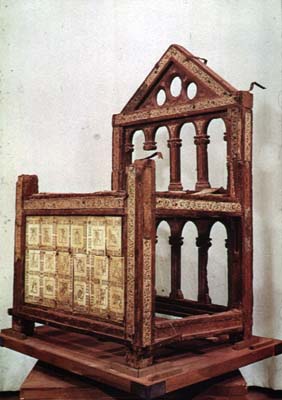 |
Cathedra Petri (Throne of St. Peter) Charles II the Bald, 823-877. Rome, St. Peter, Vatican Made for Carolingian monarch Charles the Bald; probably donated on his coronation, Christmas Day, 875 |
The heir of Constantine
— palace, chapel at Aachen—modeled on Ravenna, last W. Imperial capital
promotion of Roman/Christian culture
architecture
education
monasteries; palace
book copying, handwriting reform
visual arts: mainly church-related
 |
 |
Aachen, Palatine Chapel
 |
 |
Ravenna, S. Vitale

Plans compared: S. Vitale, Palatine Chapel
Christianity and Church as force for peace and order
literate culture and classical traditions
new writings:
some preservation of oral vernacular poetry
devotional and religious works
histories
official correspondence and documentation
personal correspondence
 |
Carolinian minuscule. Text with decorated initials, from a Gregorian Sacramentary St. Gall?; c. 825-50, subsequently used at the abbey of St. Alban, Mainz Bodleian Library, MS. Auct. D. 1. 20, fol. 116r |
 |
St. Matthew. Coronation Gospels of Holy Roman Empire, 790-810 |
Historia Augusta, Vatican Library
Euratlas Historical Maps
News Flash: Carolingian Minuscule Predates Charlemagne (by some decades)
— from the German Ministry of Education and Research
Suetonius, Lives of Caesars
e-sequence Sequences by Notker
Map: Frankish expansion 481-814


Siena, Palio: Carroccio (ox cart)
