Latest Studies

November 4, 2025
Seasonal variations of tropical cyclone genesis and landfall patterns impacting Southeast Asia in a warmer climate
Graduate student, Mackenzie (Kenzie) Weaver, led collaborators from Rowan University, the Earth Observatory of Singapore and University of Hong Kong in identifying a shift in tropical cyclone genesis under future climate scenarios. The study highlights seasonal changes in storm landfall, demonstrating the need for improvement in coastal resiliency and mitigation strategies in regions of Southeast Asia.
July 14, 2025
Intensification of the strongest nor'easters
In a new PNAS study led by Kevin Chen (Penn C’24) and Mann Research Group coauthors, we examine trends in the characteristics of U.S. east coast winter storms, known as nor’easters. Using a cyclone tracking approach combined with long-term reanalysis data, we present a comprehensice historical record of Atlantic nor’easters and reveal that the strongest nor’easters are becoming stronger, suggesting further coastal risks in a warming climate.


June 16, 2025
Increased frequency of planetary wave resonance events over the past half-century
Dr. Xueke Li and collaborators are the first to demonstrate a historical trend in planetary wave resonance over the past half-century. We find that the average number of resonance events per year has tripled since the advent of adequate upper atmospheric measurements in the mid-20th century, rising from about 1 event per year in 1950 to now about 3 per year.
June 02, 2025
Sensitivity of simulations of Plio–Pleistocene climate with the CLIMBER-2 Earth System Model to details of the global carbon cycle
In a new study led by former Mann Research Group postdoctoral researcher, Judit Carrillo, path dependence was reassessed in the history of glacial/interglacial cycles over the past 3 million years. We expand on our 2024 PNAS article to demonstrate that path dependence (or hysteresis) is highly threshold-dependent based on the model’s global carbon cycle.


May 13, 2025
Behavioral interventions motivate action to address climate change
Penn Center for Science, Sustainability and the Media postdoctoral researcher, Allie Sinclair, along with Dr. Michael Mann, Dr. Emily Falk and the Communication Neuroscience Lab share what motivates people to take action and share information about climate change. In this study, they identify barriers one may face in taking climate action and test 17 different intervention strategies
💡 Take home idea: encourage people to think about the future outcomes of climate change for themselves and the people they care about to motivate action and spread ideas to address challenges under a changing climate.
June 17, 2024
Path-dependence of the Plio–Pleistocene glacial/interglacial cycles
In a new study led by Mann Research Group postdoctoral researcher, Judit Carrillo, hysteresis was identified in a model of intermediate complexity (CLIMBER-2) over the past few million years, most notably across the Mid-Pleistocene Transition (MPT). We demonstrate that in using path-dependent forcings there is a striking divergence in the history of Pleistocene glacial/interglacial cycles.


2025 North Atlantic Hurricane Prediction
Dr. Michael E. Mann and Shannon Christiansen at the University of Pennsylvania, and Penn State ESSC alumnus, Dr. Michael Kozar, have released their seasonal prediction for the 2024 North Atlantic hurricane season. This year’s prediction yields the highest storm count to date and highlights the impacts of rising sea surface temperatures and changes in ENSO states.
Highlighted Publications

2021 Pacific Northwest "Heat Dome"
Dr. Xueke Li, Mann Research Group postdoc, and Dr. Michael E. Mann lead collaborators in a new article published in PNAS showing the precursor role that atmospheric resonance has in the 2021 Pacific Northwest “Heat Dome” event. The study found that interactions between planetary-scale atmospheric waves and local soil moisture conditions played a role in the unprecedented extreme.

Compound Drought and Heatwave Events
Dr. Michael E. Mann and collaborators lead by Kumar P. Tripathy investigated the risk of compound drought and heatwave events (CDHW) under “worse-case” climate change scenarios. In this new study, they found the effects of climate change increases the intensity, duration and frequency of CDHW events, and comment on the threat extreme heat has on socioeconomic factors.

Another Year of Record Heat
Lijing Cheng, and numerous collaborators including Dr. Michael E Mann, have once again extended previous research to conclude that the world’s oceans were a record warm in 2022, despite the presence of La Niña conditions, for another consecutive year.

Past and Future Ocean Warming
Lijing Cheng and collaborators, including Dr. Michael E. Mann, outline the drivers and consequences of past and future ocean warming though monitoring ocean measurements and analyzing model simulations.

Irreversible Decline in Freshwater Storage
Dr. Michael E. Mann and collaborators have found that climate change threatens terrestrial freshwater storage over the Tibetan plateau. Irreversible declines in freshwater storage are projected for parts of Asia by 2060.

Region Specific Shifts in the ITCZ
Dr. Byron Steinman, and collaborators including Dr. Mann, analyzed paleoclimate records and model simulations of precipitation change in the neotropics that span the preindustrial last millennium to assess ITCZ behavior on multicentury timescales. They demonstrate that the ITCZ shifted southward during the Little Ice Age in the Atlantic basin in response to relative cooling of the Northern Hemisphere driven by volcanic forcing, which contrasts with studies suggesting that changes in ITCZ width and/or strength, rather than a change in mean position, occurred during the Little Ice Age.
Previous Highlighted Studies:
Another record: Ocean warming continues through 2021 despite La Niña conditions
Lijing Cheng, and numerous collaborators including Dr. Michael E. Mann, have extended previous research to conclude that the world’s oceans were again record warm in 2021, for the sixth consecutive year, despite the presence of La Niña conditions.
Read the study (Web version on the journal Web site) >>
Read the study (printable version on the Mann Web site) >>
Read a press release from SciTechDaily >>
View a supplementary video produced by the authors>>

Read news coverage of the study:
Heat stress in U.S. may double by the end of the century
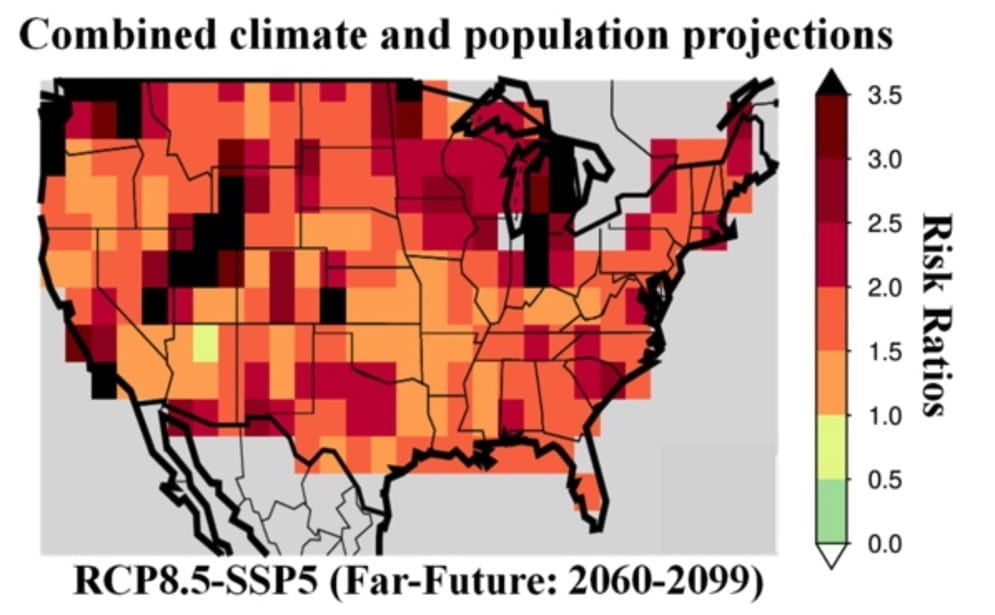
Dr. Michael E. Mann and collaborators Sourav Mukherjee (lead author), Ashok Kumar Mishra, and Colin Raymond published a study that shows that areas of the United States with increasing populations will likely experience even higher increases in heat stress.
Apparent Atlantic warming cycle likely an artifact of climate forcing
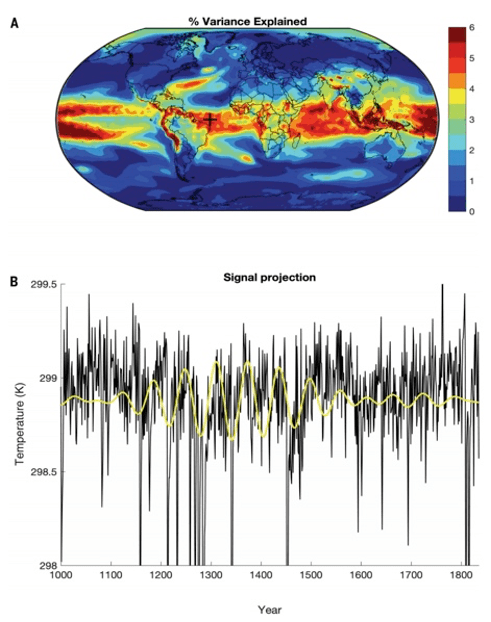
ESSC scientists Dr. Michael E. Mann and Daniel J. Brouillette and alumni scientists Dr. Byron Steinman and Sonya Miller have published a study that further confirms that the so-called Atlantic Multi-Decadal Oscillation is indistinguishable from the background noise of internal climate variability and is an artifact of climate forcing and that additionally finds that it tracks closely with volcanic forcing over the past millennium.
Other Studies:


